Hotcoin TradFi Asset List: Which Instruments Are Available and How Do You Filter Them?
Hotcoin TradFi can be filtered by spot, futures and asset category, and you need to check both the ticker and the product type when choosing. We place price-related products such as stocks, ETFs, metals, commodities and forex in the same trading entry so users can look for opportunities across different markets. This article collects verified representative instruments and filtering methods; it does not mix spot tickers with futures tickers, and it does not read a company name shown on a page as stock ownership.
Data updated: 8 September 2026. Tickers and screenshots come from live page checks on 7 September 2026; the list below covers verified instruments only, is not a full export of the site and does not guarantee that every account can trade them. Always rely on the relevant product page for the latest listings, delistings, trading status and eligibility.
Which Asset Categories Does Hotcoin TradFi Cover?
Hotcoin TradFi asset categories include stocks, ETFs, metals, commodities, indices and forex, but spot and futures coverage is not identical. When filtering, first decide the trading form, then look for related markets; never assume that a product in the futures list is automatically live on spot. The US, Hong Kong, Japan or Korea tags in the names help identify the related market, but the actual trading instrument is still the specific product the page labels, not an abstract asset category.
Categories and product rules: Hotcoin TradFi FAQ.
Which Instruments Are Available on Spot?
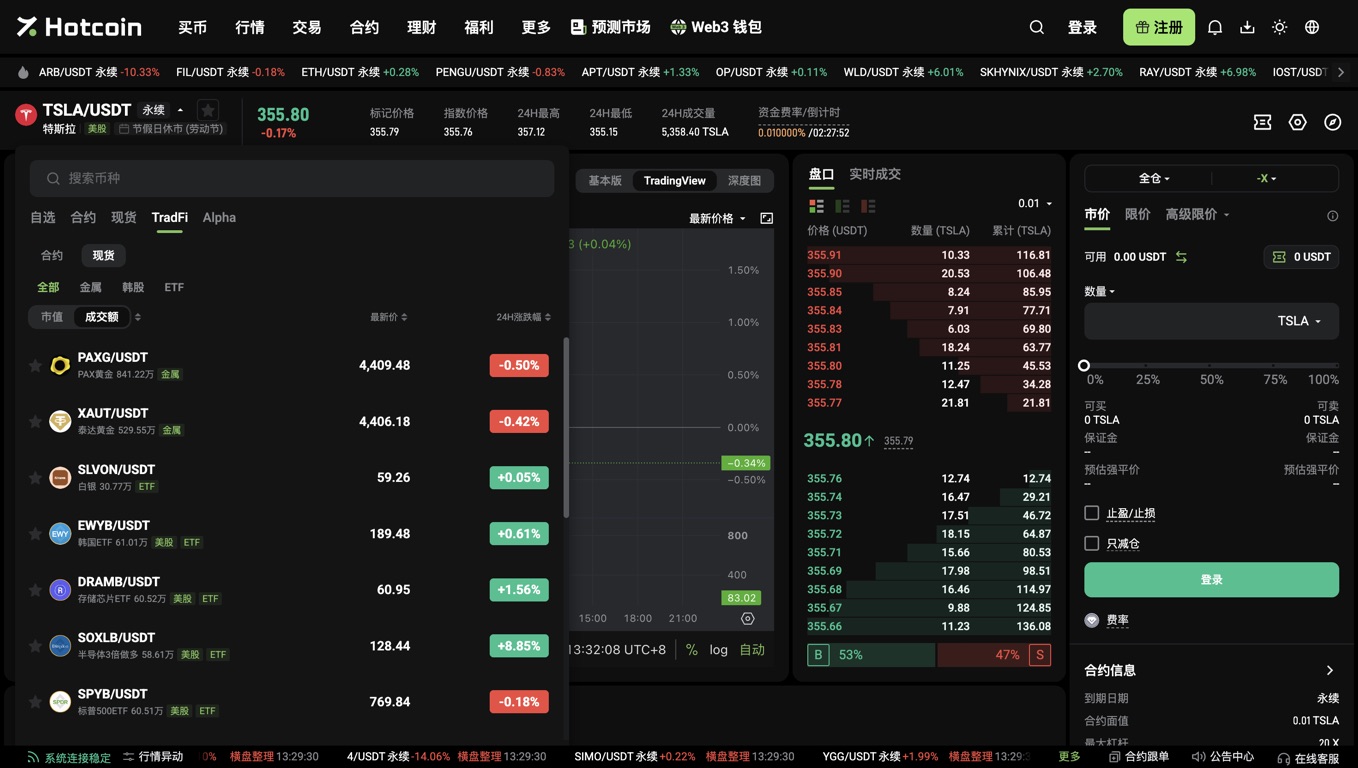
The TradFi spot list includes gold-related products and stock- and ETF-related products, some of which carry a multiple or inverse strategy description in the name. For example, SPYB/USDT and SOXLB/USDT share the same spot entry but link to different strategies. When choosing a spot product, read the ticker, the underlying asset and the product description carefully: the word spot alone does not prove that there is no embedded leverage risk, and a ticker suffix alone does not establish the issuer or any stock custody arrangement.
| Category | Verified spot tickers | Product name or identification point |
|---|---|---|
| Gold | PAXG/USDT, XAUT/USDT | PAX Gold and Tether Gold; not stocks. |
| Broad-market and regional ETF related | SPYB/USDT, EWYB/USDT | S&P 500 ETF and Korea ETF. |
| Sector and commodity ETF related | DRAMB/USDT, SMHB/USDT, SLVON/USDT | Memory chip ETF, semiconductor ETF and a silver-related product. |
| Korea stock related | SKHYB/USDT | A SK hynix-related product. |
| 2x strategy related | INTWB/USDT, MUUB/USDT, MVLLB/USDT, SNXXB/USDT | 2x long strategies linked to Intel, Micron, Marvell and SanDisk respectively. |
| 3x and inverse strategy related | SOXLB/USDT, KORUB/USDT, TQQQB/USDT, SOXSB/USDT | 3x long semiconductors, 3x long Korea, 3x long Nasdaq 100 and 3x short semiconductors. |
Which Instruments Are Available on Futures?
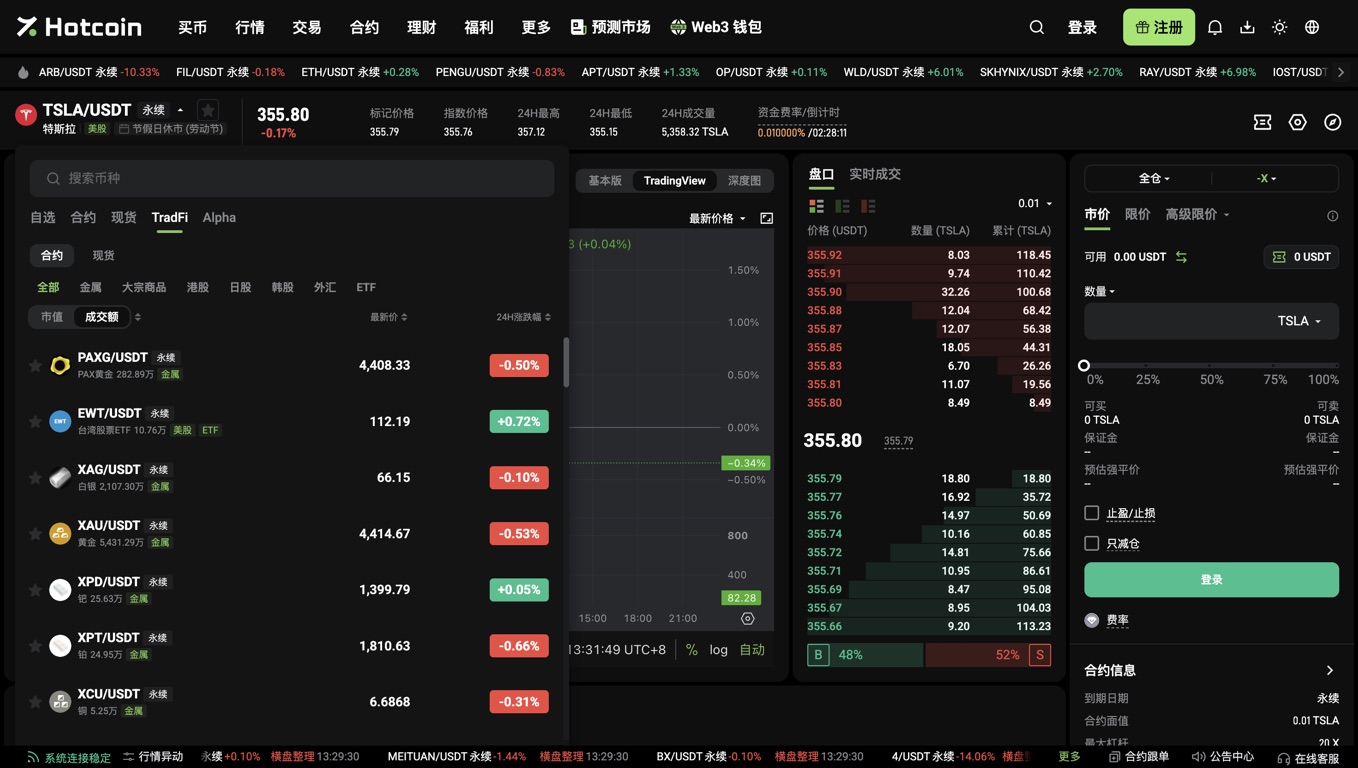
TradFi futures covers not only stock-related perpetuals such as TSLA/USDT but also metals, commodities, forex and ETF-related instruments. The underlying asset in a futures name only indicates the price linkage; before ordering you still need to check the contract size, the quantity unit and the position tiers. A single market may carry a single-asset product, an index product or a leveraged ETF-related product at the same time, and being in the same sector does not mean the same source of volatility and the same risk.
| Category | Verified perpetual futures tickers |
|---|---|
| US stocks | TSLA/USDT, NVDA/USDT, MU/USDT, SNDK/USDT |
| Metals | PAXG/USDT, XAU/USDT, XAG/USDT, XPD/USDT, XPT/USDT, XCU/USDT, XNI/USDT, XAL/USDT, XPB/USDT |
| Energy commodities | CL/USDT, BZ/USDT, NG/USDT, NATGAS/USDT |
| Forex | EURUSD/USDT, GBPUSD/USDT |
| Hong Kong stocks | TENCENT/USDT, MEITUAN/USDT, XIAOMI/USDT, KUAISHOU/USDT, POPMART/USDT, SMIC/USDT |
| Japan stocks | KIOXIA/USDT, SOFTBANK/USDT |
| Korea stocks and indices | SKHYNIX/USDT, SAMSUNG/USDT, HYUNDAI/USDT, LGELECTRONICS/USDT, SAMSUNGEM/USDT, HANMI/USDT, NAVER/USDT, KR200/USDT |
| ETF examples | EWT/USDT, EWJ/USDT, EWY/USDT, EWZ/USDT, IWM/USDT, SMH/USDT, DRAM/USDT, KWEB/USDT, XLE/USDT, XBI/USDT, GDX/USDT, URNM/USDT, SHLD/USDT |
| Leveraged and inverse strategy examples | SOXL/USDT, KORU/USDT, MUU/USDT, RAM/USDT, INTW/USDT, SNXX/USDT, UVXY/USDT |
The list is grouped by main related market and is not a complete set of product terms. For example, NG and NATGAS should not be treated as interchangeable just because both names relate to natural gas, and volatility-related products such as UVXY cannot be understood as ordinary company shares.
How Do You Filter TradFi Instruments on the Web?
On the Hotcoin trading page, click the trading pair name in the top left corner, switch to TradFi in the selector, then choose spot or futures. From there you can search for a ticker with the search box or narrow the range using the visible categories such as metals and ETF. After opening a result, also verify the full trading pair and the perpetual marker; filtering only completes the search — it does not mean the product suits your trading objective or that your current account can open a position right away.
How Do You Narrow the Filtered Results to Products Worth Researching?
When filtering TradFi products, compare the source of risk first and the trading cost second, instead of simply picking the ticker with the largest daily gain. A single company is more exposed to earnings and operating events, a broad-market ETF is affected by both its constituents and macro conditions, and forex and commodities have different pricing factors. On the specific product page, keep checking the bid-ask spread, order book depth, market status and fees; for futures, also verify leverage and funding rates rather than judging by turnover alone.
FAQ
Why does the same asset have different tickers on spot and futures?
Spot and futures may use different product tickers because they correspond to different trading structures, not because one is a simple copy of the same-named asset. For example, SMHB/USDT on the spot list and SMH/USDT on the futures list should each be checked against their own product description and trading rules. A letter suffix alone does not prove the issuer, the on-chain standard or redemption rights; check by full ticker before choosing, and never infer that another product exists just by removing a suffix.
If a product is on the list, can I trade it right now?
A product appearing on a list does not mean any account can fill an order at any time. Account eligibility, regional restrictions, product maintenance, market closures and order parameters can all affect actual execution. Futures may also enter reduce-only mode, where existing positions can be reduced but no new risk exposure can be added. After finding a product, keep checking the page notices and your account status, and do not treat publicly visible quotes or a still-updating price as proof that trading permission has been granted.
Why does the list need to be updated regularly?
The TradFi product list changes with listings, delistings, ticker adjustments and product rule changes, so a static list in an article can only correspond to a specific verification date. In practice, search again in the product selector first, then open the detail page to check the trading form and current status. For old tickers you have saved, also watch for related announcements; do not assume a product is still trading, unchanged in specification or available in every region just because an earlier article or screenshot listed it.
Where to check: Hotcoin TradFi. This article is for product identification and is not investment advice.
Recommended
View more