
Merkle Root Hash
Hotcoin uses a Merkle Tree to verify that all user assets are backed by reserves at a 1:1 ratio.
--

Hotcoin maintains 100% reserve backing for user assets and regularly discloses information including Merkle Tree proofs, reserve assets, and reserve ratios, giving users a clearer view of the platform’s reserve status.



Reserve Ratio = Platform Reserves ÷ User Assets. A reserve ratio of 100% or higher means the platform holds sufficient reserves to fully cover user assets.
Hotcoin uses a Merkle Tree to verify that all user assets are backed by reserves at a 1:1 ratio.

Users can easily verify whether their assets have been included in the current Proof of Reserves.
Verify NowProof of Reserves (PoR) is an auditing mechanism used to verify that a trading platform holds sufficient reserves to cover user assets. Through on-chain wallet proof, user asset snapshots, and cryptographic verification, PoR confirms that the platform’s eligible reserve assets are sufficient to cover user assets. Hotcoin takes snapshots of user account asset data and uses a Merkle Tree to aggregate and verify the data. Each user can verify that their assets have been included in the Merkle Tree and therefore form part of the total user assets disclosed by the platform. A reserve ratio of 100% or above indicates that the platform’s reserve assets cover user assets at a ratio of at least 1:1. The PoR verification code has been made open source on GitHub, allowing users to verify the results independently.
Hotcoin takes a snapshot of user account asset data and uses a Merkle Tree to aggregate the data and verify its integrity. Each user can verify that their asset data is included in the Merkle Tree and, in turn, in the total user assets published by the platform.
When the reserve ratio is 100% or higher, it means that the platform holds sufficient reserves to cover user assets at a 1:1 ratio or greater.
The Proof of Reserves verification code has been open-sourced on GitHub, allowing users to perform independent verification.

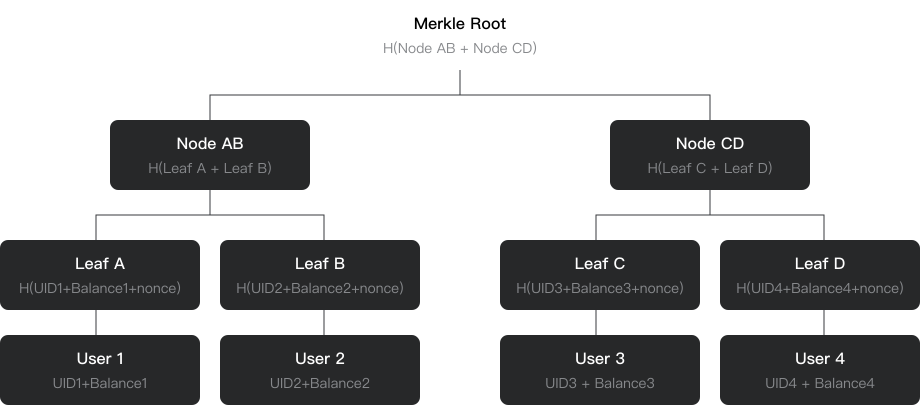
A Merkle Tree is primarily used to verify data integrity. Each leaf node represents a user account, where the account balance and related information are hashed using SHA-256 and recursively calculated with neighboring nodes to generate the Merkle Root. When verifying Proof of Reserves, users can generate their own account hash and combine it with the relevant neighboring nodes in the Merkle Tree to calculate upward and reconstruct the Merkle Root. If the reconstructed Merkle Root matches the one published by Hotcoin, it proves that the user's assets have been correctly included in the Proof of Reserves and that the data has not been tampered with.
When verifying Proof of Reserves, users can generate a hash based on their account information and combine it with adjacent nodes in the Merkle tree, calculating upward level by level until the final Merkle root is obtained.
If the Merkle root calculated by the user matches the one published by the platform, this confirms that the user’s asset data has been correctly included in the current Proof of Reserves and that the relevant data has not been altered.
As shown below:
service@hotcoin.com
Product@hotcoin.com
Business@hotcoin.com
Casecn@hotcoin.com