The Complete Guide to Decentralized Exchanges (DEX)
A decentralized exchange (DEX) is a crypto asset trading platform that runs on blockchains and smart contracts. Users usually interact with on-chain protocols directly through their own wallets, without handing assets over to a centralized platform for long-term custody. Unlike traditional order book trading, many DEXs rely on AMMs and liquidity pools to quote prices and settle swaps, which also brings its own risks such as slippage, MEV, smart contract bugs and fake tokens.
What is a DEX?
DEX stands for Decentralized Exchange.
The simplest way to think about it: a CEX is closer to "putting your assets into an account on a trading platform to trade", while a DEX is closer to "connecting a wallet and trading directly with an on-chain smart contract."
On a centralized exchange, users usually need to register an account, complete identity verification and deposit assets into a platform account, and the platform matches buy and sell orders internally.
A DEX typically does not require users to deposit assets into a centralized custodial account. Users connect their own wallet, choose the token and amount, and the trade request is ultimately executed by a smart contract on the blockchain.
That said, "decentralized" does not mean there is no front end, router or infrastructure at all. The trading page users see is only a layer of interface for interacting with an on-chain protocol; the core that actually swaps assets is still smart contracts and on-chain liquidity.
What is the difference between a DEX and a CEX?
The biggest difference between a DEX and a CEX is not simply that one is decentralized and the other centralized, but that asset control, trade execution and where platform responsibility sits are all different.
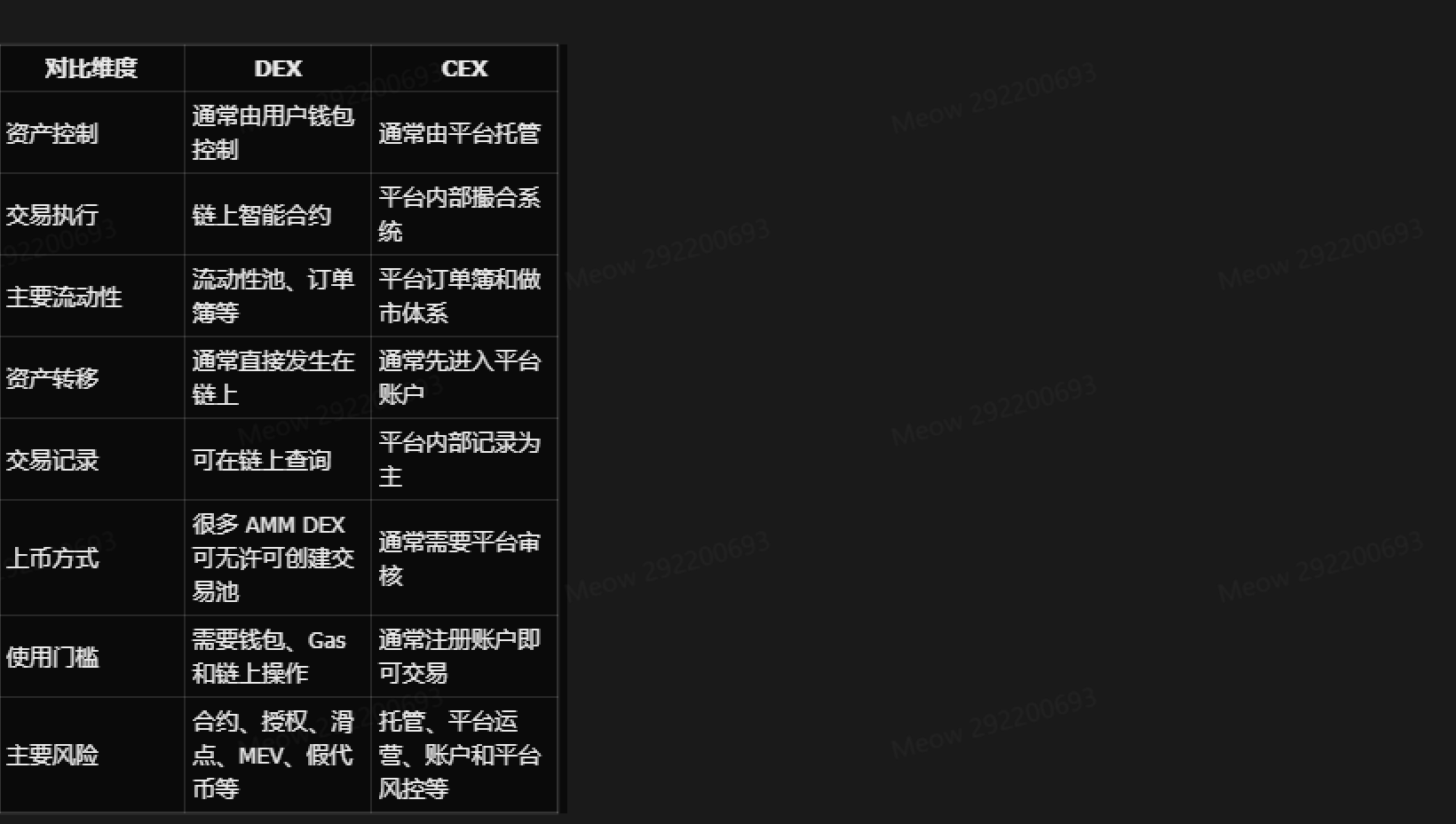
One point deserves special attention here: a DEX is not inherently safer than a CEX.
A DEX converts part of the platform custody risk into operational responsibility for the user. Private keys, seed phrases, token approvals, transaction signatures, contract addresses and network selection all have to be judged by users themselves.
How does a DEX complete a trade?
Taking the most common AMM-style DEX as an example, a simple token swap roughly goes through the following process:
Connect wallet → Select trading pair → Get a quote → Check price impact and slippage → Sign the transaction → Smart contract executes → On-chain confirmation → Tokens arrive in your wallet
For example, suppose you want to swap USDT for ETH.
You enter "1000 USDT", and the DEX calculates how much ETH you can expect based on currently available liquidity, while showing trading fees, price impact and the minimum received amount.
After you confirm, your wallet asks you to sign the transaction. Once the transaction is broadcast and included in a block, the smart contract executes the swap according to the on-chain state at that moment.
There is an important distinction here:
The quote shown on the DEX page is only an estimate you see before the transaction is submitted; the final result depends on the on-chain state when the transaction actually executes.
So DEX trading cannot be judged by "the current price" alone. Liquidity, price impact, slippage and the execution environment all matter.
AMM is one of the core mechanisms of a DEX
Many mainstream DEXs do not use a traditional order book; they use an automated market maker (AMM).
The core idea of an AMM is: buyers and sellers do not have to post orders at the same time; instead, assets are placed into liquidity pools and a smart contract automatically calculates the trading price according to preset mathematical rules.
For a classic constant product AMM, the most common formula is:
x × y = k
Where:
x: the amount of Token A in the liquidity pool
y: the amount of Token B in the liquidity pool
k: the constant product that must be maintained during trading
When a user buys one token out of the pool, the other token in the pool increases, the ratio of the two assets changes, and the price changes along with it.
For example, a pool holds a large amount of ETH and USDC. If users keep buying ETH with USDC, the amount of ETH in the pool falls, the amount of USDC rises, and the price of ETH relative to USDC changes.
This is why an AMM can keep providing quotes without a traditional order book.
If you want to dig into the mathematics behind it, continue with AMM Explained: The Mathematical Beauty of x*y=k.

What is a liquidity pool? Who provides assets to a DEX?
For a DEX to complete trades, it first needs enough liquidity.
In the AMM model, liquidity is usually held in liquidity pools controlled by smart contracts. Taking a classic two-asset pool as an example, users can supply both tokens to the pool and become liquidity providers (LPs).
Other traders then use the assets in the pool to swap.
So a DEX trade actually forms a relationship like this:
LPs provide liquidity → liquidity enters the pool → traders trade against the pool → trades generate fees → LPs earn a share of the returns according to the rules
But LPs are not risk-free either. Token price changes can create price risk and impermanent loss, and concentrated liquidity models also require LPs to manage price ranges.
Therefore, "providing liquidity to a DEX" and "trading on a DEX" are two completely different activities.
Why can the same token have different prices on different DEXs?
A DEX has no single global "official price".
Different trading pools hold different amounts of assets and have different depth and trading activity, so quotes can differ.
For example:
DEX A: ETH/USDC quoted at 3,000 USDC
DEX B: ETH/USDC quoted at 3,010 USDC
Such price differences can be exploited by arbitrage traders.
Arbitrageurs buy in the cheaper market and sell in the more expensive one. As arbitrage trades happen, the price gap between markets is usually compressed, at least partially.
So the price you see on a DEX should be understood as an executable quote along a specific trading path and in a specific liquidity environment, not an absolute number detached from market depth.
What are the mainstream DEXs? How do you choose between them?
DEXs are not all the same product. Different protocols may use different AMMs, order books, routing and trading mechanisms.
Uniswap: the flagship of AMM DEXs
Uniswap is one of the most representative AMM-style DEXs, and its core is completing token swaps through smart contracts and liquidity pools. As the protocol evolved, its liquidity model also moved from early full-range liquidity to more complex designs such as concentrated liquidity. Uniswap v4 today further introduces architectures and extension mechanisms such as Singleton and Hooks.
If you want to understand why Uniswap became the flagship of AMM DEXs and how it changed from early versions to later architectures, read Uniswap Deep Dive: The Evolution of a DEX Leader.
PancakeSwap: an important DEX in the BNB Chain ecosystem
PancakeSwap is a multi-chain DEX whose early ecosystem was closely tied to BNB Chain, and its trading system now supports multiple liquidity sources and routing mechanisms.
Its Smart Router can use different liquidity sources depending on the trade and supports multi-hop and split routing to improve the execution of some trades.
If you mainly work in the BNB Chain ecosystem, learn more in PancakeSwap: The DeFi Leader on BNB Chain.
dYdX: leaning toward professional trading and perpetuals
Not every DEX focuses on spot token swaps.
dYdX is better understood from the perspective of decentralized derivatives trading, and its trading infrastructure includes order books, market data and perpetual contracts. The official developer documentation currently also provides interfaces for markets, orders, accounts and perpetual markets.
So if your goal is to understand decentralized perpetual contract trading, read dYdX: A Decentralized Perpetual Exchange.
What is a DEX aggregator? Why not compare multiple DEXs manually?
If a token exists on several markets such as Uniswap and PancakeSwap at the same time, users could in theory open each DEX and compare prices.
But that raises a problem:
The "best price on a single DEX" you see is not necessarily the best execution price across the whole market.
The job of a DEX aggregator is to look at multiple liquidity sources at once and find a more suitable execution route based on trade size, liquidity and path.
For example, suppose you want to swap USDC for a certain token.
A direct trade might be:
USDC → Token A
The aggregator may find a better route:
USDC → ETH → Token A
Or even split the trade into:
60% via Route A + 40% via Route B
The ultimate goal is not simply to find a DEX's "listed price", but to find a better actual execution result.
Aggregators such as 1inch route and split trades precisely by aggregating multiple DEXs and liquidity sources.
To learn more about how aggregators find better trading paths, read DEX Aggregators: How 1inch Finds You the Best Price.
The three most overlooked costs of DEX trading
Many new users look at a swap page and only focus on "how many tokens can I get".
In reality, the final cost of a DEX trade usually includes more than the trading fee.
1. Gas Fee
On-chain transactions require paying a network fee.
Gas cost is not unique to DEXs; it is the network cost of executing a transaction on a blockchain.
So even if a pool offers a great quote, your real cost may still be poor if the trade needs a complex multi-hop path and network Gas is high at that moment.
2. Price Impact: your own trade pushes the price up
Price impact refers to the trade itself moving the execution price away from the pre-trade price because your trade size is large relative to the pool's liquidity.
For example, if a pool only holds a small amount of ETH liquidity and you buy a large amount of ETH in one go, you will clearly change the ETH/USDC ratio inside the pool.
This is not caused by network latency; it is caused by the trade itself.
Therefore:
The shallower the pool and the larger the trade, the more pronounced the price impact usually is.
3. Slippage: what happens between submission and execution
Slippage needs to be distinguished from price impact.
Price impact mainly comes from the effect your trade has on the pool price; slippage focuses more on the difference between the price you saw when quoted and the price you finally got executed at, which may include price changes and market moves during execution.
So it is not accurate to say:
"Slippage is just the price impact caused by trade size."
The two are related, but they are not the same concept.
To understand this systematically, continue with Slippage and MEV: The Hidden Costs of DEX Trading.
What is MEV? Why might your transaction be front-run?
There is another issue in DEX trading that ordinary users easily overlook: MEV.
MEV can be simply understood as certain participants extracting economic value during block production or transaction ordering by adjusting, inserting or reordering transactions.
The most typical user-facing case is the sandwich attack.
Suppose you are about to buy a token in an AMM and the trade amount is fairly large.
An attacking bot might:
See your pending transaction → buy first → your transaction executes → the price is pushed even higher → the bot sells
As a result, your trade may fill at a worse price while the bot profits from the price movement.
So a "good quote" on a DEX does not necessarily mean the final execution result will be good.
Setting slippage too wide can increase the room for unfavorable execution, while setting it too tight can make transactions fail frequently. MEV, slippage and trade size need to be considered together.
If you want to understand how this attack works in more detail, read Sandwich Attacks: How Your DEX Trade Gets Front-Run.
How should you buy and sell tokens on a DEX?
For ordinary users, a basic DEX swap can be understood as the following process:
Step 1: Prepare a wallet compatible with the target network
DEX trading requires a wallet for the corresponding blockchain network and enough of the network's native token to pay Gas.
Step 2: Confirm the token contract address
This is one of the steps new users most often overlook.
The same token name may correspond to multiple different contracts, and some people even create fake tokens with very similar names and logos.
So you should never judge an asset by its token name or logo alone.
Step 3: Check the trading pair and liquidity
Confirm that you are trading the right token, and observe the pool's liquidity and the expected price impact.
If a small-cap token has very low liquidity, a pretty-looking price on the page still does not mean you can buy or sell a large amount at that price.
Step 4: Confirm the quote and the minimum received amount
Focus on:
How many tokens you expect to receive;
Price Impact;
Slippage;
Gas;
Route;
Minimum received.
Do not look only at "how much I expect to get".
Step 5: Check approvals
The first time you use a given ERC-20 token, you may need to complete a token approval first.
This step means you are authorizing a contract to use a specific token, not simply "connecting your wallet".
For unfamiliar protocols and tokens, pay special attention to which address you are approving and how large the allowance is.
Step 6: Confirm the transaction
Check the transaction details your wallet pops up, especially the contract being interacted with, the token, the amount and the network.
If you cannot understand what the transaction does, do not sign it just because "everyone else is clicking confirm".
Step 7: Check the on-chain result
After the trade completes, you can use a block explorer to check the transaction hash, the assets in and out, the actual filled amount and the Gas paid.
If you want a systematic understanding of the full on-chain trading process, read DEX Trading Tutorial: How to Buy and Sell Tokens On-Chain.
Why does "you can buy it" not mean "you can sell it" on a DEX?
This is a question new users must understand clearly.
On many AMM DEXs, as long as someone creates a trading pool and provides liquidity, a token can become tradable.
So a token appearing on a DEX does not mean it has passed strict platform review.
The more dangerous scenario is this:
You can buy in, but the sell transaction fails, or you need an abnormally high slippage to sell.
Such cases may involve honeypots, malicious token contracts, trading restrictions, blacklist mechanisms or extremely low liquidity.
So judging whether a token is worth trading cannot rely only on: "Is anyone buying right now?"
The better question is:
"After I buy in, is there a path to exit normally?"
What are the advantages of a DEX?
The reason a DEX can survive long term and grow quickly is not just the word "decentralized".
Self-custody
Users can usually trade directly with their own wallet, without keeping assets in a centralized trading account long term.
Openness
Many AMM protocols allow anyone to create trading pools and trade on-chain without traditional listing approval. PancakeSwap, for example, states in its official documentation that users can make a token tradable by creating a liquidity pool.
This creates trading opportunities for a huge range of long-tail and new assets, but it also means users must identify fake tokens and risky projects themselves.
Transparency
Trades, liquidity pools and smart contract interactions can usually be queried on the blockchain.
Users do not have to rely entirely on data displayed inside a platform, and can verify further through on-chain records.
Composability
A DEX is not just a "trading website".
Other DeFi protocols, wallets, aggregators and applications can all call on on-chain liquidity, so a DEX can become basic liquidity infrastructure for a larger DeFi ecosystem.
What are the risks of a DEX?
The advantages and risks of a DEX are really two sides of the same coin.
Smart contract risk
If the protocol code has vulnerabilities, attackers may exploit them and put funds at risk.
Fake token risk
A listing mechanism without traditional review increases openness, and also lowers the barrier to creating fake tokens.
Liquidity risk
Insufficient liquidity can cause huge price impact, and may even make it very hard to exit normally.
Slippage and MEV risk
Large trades or low-liquidity trades in particular need attention to price impact, slippage and front-running.
Wallet approval risk
Malicious websites may trick users into approving tokens or signing dangerous transactions.
Cross-chain risk
If a trade involves a cross-chain bridge or cross-chain assets, the risks of the bridge and the cross-chain infrastructure apply on top.
So a DEX is not "no platform, no risk"; rather, it hands more of the judgement responsibility to the user.
How should beginners choose a DEX?
Do not choose simply by "which DEX is the biggest".
A more practical approach is to judge based on your trading needs:
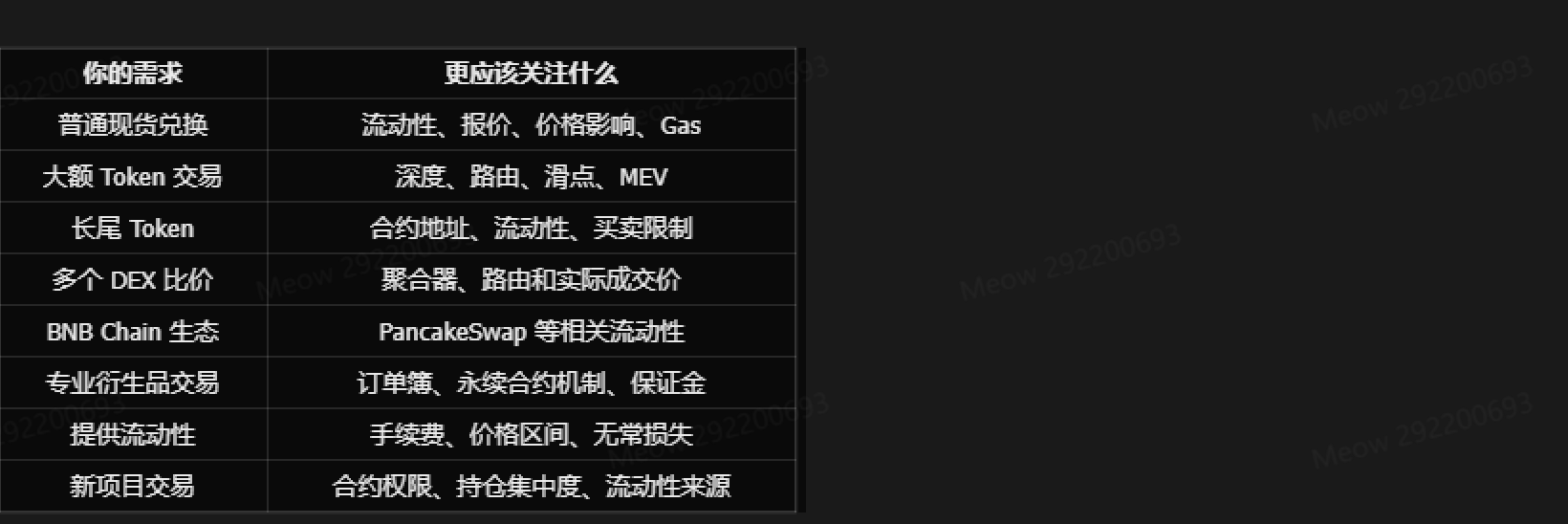
The logic for a genuinely good DEX choice is not:
"Which platform is the most popular?"
but rather:
"In which trading scenario does it give me a better actual execution result?"
Understanding the full DEX trading chain in one picture
You can think of a DEX as the following structure:
Wallet
↓
DEX front end
↓
Router / Aggregator
↓
Liquidity pool / Order book
↓
Smart contract
↓
Blockchain network
↓
Tokens arrive in the user's wallet
And the variables that affect the final trading result mainly include:
Liquidity + Routing + Trade size + Price Impact + Slippage + Gas + MEV
This is also why judging a DEX should not rely only on the token price shown in the interface.
FAQ: Common questions about DEXs
What does DEX mean?
DEX is short for Decentralized Exchange. It usually completes digital asset trades through blockchains and smart contracts, and users can interact with on-chain protocols directly using their own wallet.
Which is better, a DEX or a CEX?
There is no absolute answer. DEXs emphasize self-custody, openness and on-chain trading, while CEXs are usually more convenient for account management, fiat on-ramps and trading experience. Which to choose depends on your trading needs, how you manage assets and your risk tolerance.
Why is there slippage in DEX trading?
Because the on-chain quote and the final execution can differ in price, and AMM trades are also affected by pool liquidity and trade size. Slippage needs to be understood separately from price impact.
Why can some tokens on a DEX be bought but not sold?
It may relate to malicious contracts, trading restrictions, blacklist mechanisms, extremely low liquidity or other token design choices. So before trading you must confirm the token contract and the actual exit conditions.
Does DEX trading require fees?
Usually yes. Besides the trading fee a DEX itself may charge, on-chain transactions also require paying network Gas; the exact cost depends on the protocol, trading path, network conditions and transaction complexity.
Do you need to register an account to use a DEX?
Usually not in the traditional sense of a trading account. Users generally connect a wallet compatible with the target network to the DEX, then sign on-chain transactions with that wallet.
Is a DEX completely anonymous?
It cannot simply be treated as fully anonymous. Although many DEXs do not require traditional account registration, addresses, transactions and fund flows on a blockchain are usually publicly queryable. Whether an address can be linked to a real-world identity depends on the specific situation.
Summary
The core value of a DEX is moving digital asset trading from a centralized account system onto wallets, smart contracts, liquidity and blockchain networks.
To understand DEXs, the most important thing is not memorizing the names Uniswap, PancakeSwap, dYdX or 1inch, but understanding what each of them solves:
AMM: automated quoting through liquidity pools and mathematical models;
DEX: on-chain infrastructure for swapping assets;
Aggregators: finding and combining multiple liquidity sources;
Order book DEXs: matching closer to how traditional trading markets work;
Slippage and Price Impact: determining the final execution quality of a trade;
MEV: affecting transaction ordering and the result users actually get;
Wallets and smart contracts: determining how users really complete on-chain interaction.
For ordinary users, the most important principle when using a DEX is not chasing the lowest fee or the highest yield, but first confirming that the asset you are trading is correct, the contract is trustworthy, liquidity is sufficient, the actual execution price is reasonable, and you understand the transaction you are about to sign.
Risk warning: DEX trading involves multiple risks, including digital asset price volatility, insufficient liquidity, smart contract vulnerabilities, token contract risks, wallet approvals, slippage, MEV, network congestion and cross-chain infrastructure. The openness of a DEX does not mean that trading is safe or that asset value is guaranteed. Before trading on-chain, please fully understand the relevant mechanisms and risks, and act prudently according to your own risk tolerance.
Recommended
View more