Altcoin Season Index Explained: How to Tell When Altseason Starts
The Altseason Index measures how far capital is rotating from Bitcoin into altcoins, helping investors see whether altcoins as a group are entering a sustained phase of relative strength.
In crypto market cycles, Bitcoin usually moves first, and part of that capital then flows into smaller, higher-beta altcoins — the phenomenon known as "altseason". The Altseason Index quantifies the strength of that rotation, so you can judge more objectively whether the market is still Bitcoin-led or whether altcoins are outperforming as a group.
What Is Altseason?
Altseason usually refers to a stretch in which most altcoins post gains well ahead of Bitcoin, risk appetite rises, and capital is willing to chase higher-beta assets.
Typical features include:
Bitcoin dominance (BTC Dominance) falling
A large number of altcoins strengthening against BTC
Faster sector rotation and widening narratives
Trading activity spreading from the largest assets into small- and mid-cap names
Altseason is not a switch that flips on in a single day. It is closer to a process that builds from weak to strong.
What Is the Altseason Index
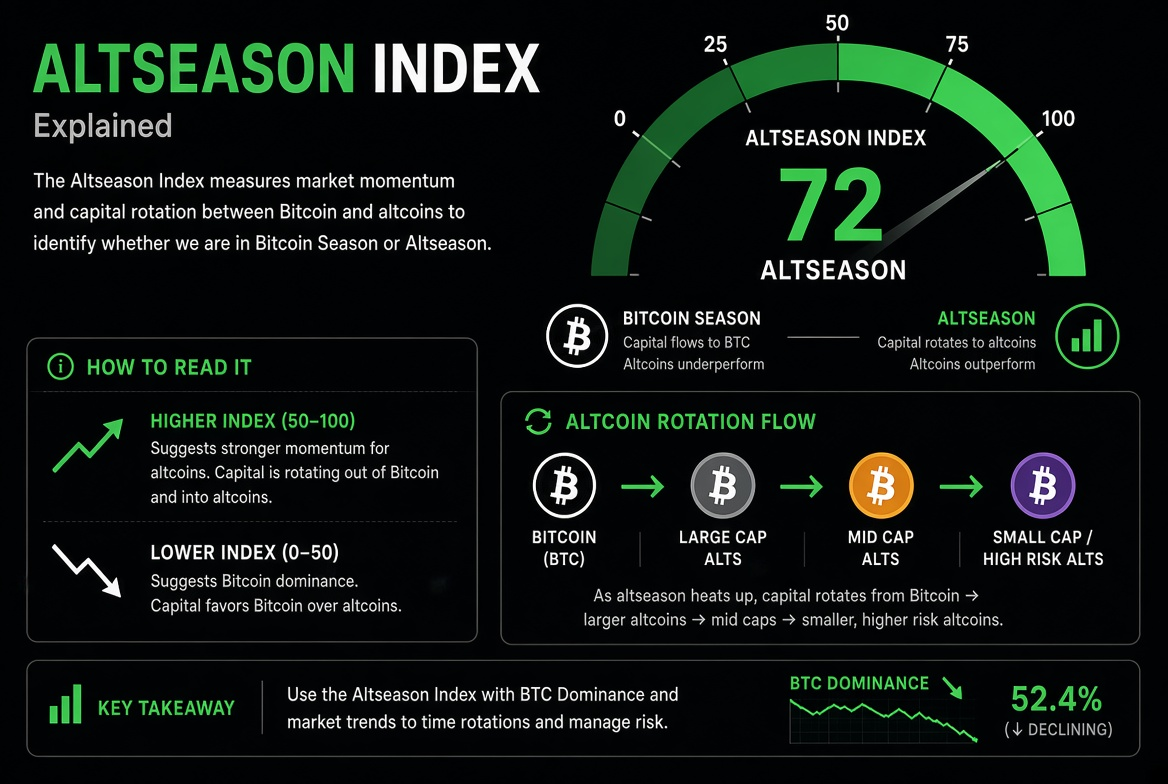
The Altseason Index is a metric for whether altcoins as a group are outperforming Bitcoin. Common versions track what share of major altcoins have outperformed BTC over a given window, such as the past 90 days.
How it is usually read:
Index near the top of its range (above 75, for example): more altcoins are beating Bitcoin and altseason characteristics are pronounced
Index in the middle: rotation is under way but has not spread across the market yet
Index at the low end: the market is more Bitcoin-led and altcoins are lagging
Different platforms use different samples, windows and thresholds, so the index is better suited to reading the trend than to fixating on one round number.
How to Tell Whether Altseason Has Started
One index on its own is not enough. Use a set of confirmations:
Watch whether the Altseason Index itself is rising. A sustained climb from low levels means more and more altcoins are starting to outperform BTC.
Watch Bitcoin dominance (BTC Dominance). When BTC's share rolls over from a high, it often means capital is starting to spread into other coins.
Watch how ETH and leading altcoins perform against BTC. Ethereum and large-cap altcoins turning stronger before small caps is often an early rotation signal.
Look at breadth, not just a few spectacular coins. A handful of big movers does not make a real altseason; broad-based strength across many coins is far more convincing.
Watch whether risk appetite is spreading. When capital moves from BTC and ETH into small- and mid-cap names and thematic sectors, altseason is entering a deeper phase.
Common Stages of Altseason
Bitcoin leads. BTC rises first, while altcoins follow only modestly or even lag behind.
Large-cap altcoins take over. ETH and large-cap altcoins start to show stronger performance.
Broad expansion. Rotation into small- and mid-cap, high-beta sectors accelerates and the Altseason Index climbs.
Overheating and divergence. Narratives get crowded, volatility rises, some capital returns to BTC or fiat, and altcoins diverge sharply from one another.
Understanding the stage matters more than insisting on the exact day it began.
How to Use the Altseason Index in Practice
Good uses:
Judging whether the current environment favours a larger share of altcoin exposure
Identifying changes in market risk appetite
Serving as background for thematic rotation and sector research
Poor uses:
Treating it as a precise entry or exit point
Ignoring a coin's fundamentals and liquidity
Using the index as the only reason to open a position with high leverage
A practical approach:
When the index is low, lean towards BTC and high-quality assets. When the index is trending up alongside falling BTC dominance, start researching strong sectors gradually rather than piling into every altcoin at once.
Why "It Feels Like Altseason" Is Often Wrong
A single coin's big rally creates an illusion
A short-term BTC pullback distorts relative strength
Hot narratives do not equal real capital rotation
Different index definitions can lead to conflicting conclusions
So the more reliable approach is to look at all four together: index + BTC dominance + market breadth + liquidity.
Risks of Playing Altseason
Deeper drawdowns and larger swings
Illiquid coins can spike and crash
Rotation is extremely fast, and chasing highs often means buying someone else's exit
Divergence late in the cycle is severe, and most coins can give back a large share of their gains
Altseason offers higher beta and often brings harsher drawdowns. Position sizing and an exit plan matter more than catching the hot narrative.
Risk Warning
The Altseason Index is only a reference tool for market sentiment and relative strength, and it is not investment advice. Altcoins carry higher risk than Bitcoin and can see large swings or even liquidity problems. Take part carefully according to your own tolerance, and avoid using money you cannot afford to lose.
FAQ
**Q1: What reading marks the start of altseason?**A: There is no absolute threshold. Altseason characteristics are closer when the index is clearly rising alongside falling BTC dominance and improving market breadth.
**Q2: Does altseason always follow a big Bitcoin rally?**A: That order has been common historically, but it is not a law. Macro liquidity, narratives and structural changes in the market can all rewrite the timing.
**Q3: Does ETH rising on its own count as altseason?**A: Not in any complete sense. What matters more is the majority of altcoins strengthening against BTC, not one asset performing independently.
**Q4: Is altseason better for buying the dip or chasing strength?**A: The more common approach is to track relatively strong sectors while controlling position size. Blindly buying the weakest names is not necessarily safer.
**Q5: How should a beginner use the Altseason Index?**A: Treat it first as a risk-appetite thermometer. When the index is low, stay away from high-risk altcoins; when the trend turns up, research mainstream altcoins and strong sectors with small positions.
Recommended
View more